


A 60-Second Calm for Busy Mums: A Simple Stress Relief Exercise
Updated: 41 minutes ago
Some days, the noise starts before your feet hit the floor.
A child calls out. The baby needs feeding. Lunch boxes need packing. Someone can’t find their shoes, even though they’re right there. Your phone pings. The washing is still wet. You take a breath, but it doesn’t quite land.
If you’re feeling overwhelmed, you don’t always need a long bath, a full hour alone, or a perfectly quiet house to begin calming your body. Those things are lovely when they happen, but motherhood often asks for something smaller, quicker, and more portable.
This is where a 60-second calm exercise can help.
It won’t fix every problem in the room. It won’t make the toddler sleep, the school email disappear, or the mental load magically shrink. But it can give your nervous system a tiny pause. A moment to soften your shoulders. A chance to respond, rather than snap. A way to come back to yourself when everything feels like too much.
This post shares one simple exercise you can do almost anywhere: in the car before school pick-up, beside the cot, in the bathroom, in the pantry, or while standing at the kitchen bench.
It takes one minute. No equipment. No special breathing skills. No perfect mindset required.
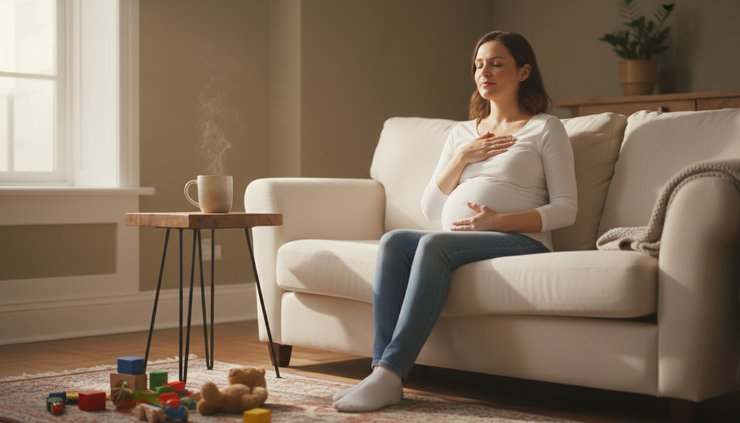
The 60-second stress relief exercise for busy mums
This exercise is called Hand on Heart Breathing.
Pause: Stop what you're doing if it's safe to do so.
Ground: Feel your feet against the floor and place one hand on your chest..
Breathe: Take two or three comfortable, unforced breaths, letting the exhale be a little longer if that feels comfortable.
Choose: Ask yourself, “What's the next one thing I need to do?”
Add one king phrase. Try one of these:
This is a hard moment, and I’m doing my best.
I can take one breath at a time.
I don’t have to solve everything this second.
I’m allowed to pause.
I can be gentle with myself.
That little phrase matters. Stress can bring harsh thoughts with it. “I’m failing.” “I should be coping better.” “Everyone else has it together.” A kinder phrase won’t erase the hard parts of motherhood, but it can reduce the extra layer of self-criticism that often lands on top.
This exercise combines gentle touch, slower breathing, and a short grounding phrase. Each part sends your body a simple message: I’m here. I’m safe enough in this moment. I can take the next step.
You don’t need to clear your mind. You don’t need to feel peaceful straight away. You’re not trying to force calm. You’re giving your body a cue that it can begin to settle.

Why one minute can make a difference
A minute can sound almost too small to matter.
When the day has gone sideways, when everyone needs something, when you’re running on broken sleep, 60 seconds can feel like a drop in the ocean.
But the nervous system responds to small signals. You don’t need to transform your whole day to create a small shift in your body.
Slow breathing can help calm the stress response
When you’re stressed, your breathing often becomes quicker and shallower. You may not even notice it. You might hold your breath while reading a difficult message, rush your exhale while trying to get everyone out the door, or breathe high in your chest while juggling too many things at once.
Slow breathing gives the body a different cue.
Research on breathing practices suggests that slow, steady breathing may help reduce feelings of stress and support emotional regulation. Reviews published in peer-reviewed journals have linked breathwork and slow breathing practices with improvements in stress and anxiety symptoms for some people, though results vary and breathing exercises are not a replacement for proper care when someone needs it.
The beauty of this exercise is that it doesn’t ask much of you. You’re not trying to meditate for 30 minutes. You’re not adding another complicated task to your list. You’re simply breathing in a way that’s a little slower and a little kinder.
Gentle touch can feel reassuring
A hand on the chest, belly, or arm can be grounding because it brings your attention back into your body.
When your thoughts are racing, the mind often jumps ahead:
What if we’re late?
What if I forget something?
Why can’t I keep up?
How am I going to get through dinner, bath, and bedtime?
Touch gives your attention a place to land.
It says, “Come back here.”
Some approaches used in compassion-focused therapy and mindfulness include soothing touch because it can support a sense of warmth and care. You don’t have to know the theory to get the benefit. You only need to notice whether it helps you feel a little more steady.
A kind phrase interrupts the inner critic
Many mums speak to themselves in ways they’d never speak to a friend.
When things feel messy, the inner critic can get loud. It might tell you that you’re not patient enough, organised enough, calm enough, fun enough, or productive enough.
That voice can feel motivating, but it usually adds pressure.
A kinder phrase gives your brain another option. It doesn’t excuse harmful behaviour, and it doesn’t pretend everything is okay. It simply brings in warmth.
Instead of “I can’t cope,” the phrase might become, “This is a lot, and I can take the next breath.”
That shift may seem tiny. But tiny shifts are often what get us through real days.
When to use this exercise for stress relief
The best time to practise is not only when everything is falling apart.
It helps to use the exercise during ordinary moments too, so it feels familiar when stress rises. Think of it like keeping a small umbrella in your bag. You don’t wait until a storm to buy one.
Here are some everyday times to try it.
Before you get out of bed
If mornings begin with instant demands, take one minute before reaching for your phone or getting up.
Place your hand on your chest. Breathe slowly. Say, “I can begin gently.”
You might still be tired. The baby might still wake. The school morning might still feel rushed. But you’ve started by acknowledging yourself, not just the to-do list.
While the kettle boils
Many homes have tiny waiting moments that get swallowed by scrolling, tidying, or mentally rehearsing the next five tasks.
While the kettle boils, try four slow breaths.
If a child is nearby, they may interrupt. That’s okay. Even two breaths count. You’re showing your body that a pause can happen inside an imperfect moment.
Before walking into school pick-up
School pick-up can be surprisingly intense. There’s traffic, noise, bags, tired children, notes from teachers, and the emotional shift from one part of the day to another.
Before you get out of the car, try the 60-second calm.
If you don’t have a full minute, take one slower exhale before opening the door. Small still counts.
After a difficult moment with your child
Maybe you snapped. Maybe your child melted down. Maybe everyone cried.
Once the immediate situation is safe, take a minute.
Not to shame yourself. Not to replay every word. Just to come back into your body.
Then you can repair if needed. A simple “I’m sorry I shouted. I was feeling really stressed, and I’m working on calming my body” can model emotional repair in a real and human way.
In the bathroom
Sometimes the bathroom is the only place you can get a sliver of privacy.
Use it.
Lock the door if it’s safe to do so. Put one hand on your chest. Breathe. Let yourself have that minute without needing to earn it.
You’re not being dramatic. You’re taking care of your nervous system.
Before sleep
Night-time can bring its own wave of thoughts. The house is finally quiet, and suddenly your brain starts listing everything you didn’t get done.
Try the exercise once you’re in bed.
Let the exhale lengthen. Let your body know the day is ending, even if the list isn’t finished.
How to make stress relief part of daily life
A stress relief tool only helps if you can actually remember it when you need it.
Busy motherhood is full of interruptions. So instead of relying on willpower, attach the exercise to something you already do.
Pair it with a routine you already have
Choose one daily anchor.
Good anchors include:
Waiting for the kettle
Sitting in the car before driving
Feeding a baby
Turning on the shower
Brushing your teeth
Closing your bedroom door at night
Standing outside your child’s room after bedtime
The routine is already there. You’re simply adding four breaths.
This makes the practice easier because your brain doesn’t have to remember a brand-new task from scratch.
Keep the expectations low
This is where many people get stuck. They try a calming exercise once, don’t feel instantly peaceful, and think it didn’t work.
But calm is not always dramatic.
Sometimes success looks like:
You paused before answering sharply
Your shoulders dropped a little
You noticed your racing thoughts sooner
You took one kinder breath
You felt 5 percent less wound up
You got through the next minute
That counts.
You don’t need to float around in perfect peace for the exercise to be useful. It’s enough for your body to get a short break from being on high alert.
Use a visual reminder
Place a small reminder somewhere you’ll see it.
It could be:
A sticky note on the kettle that says “breathe”
A small heart drawn on your planner
A phone wallpaper with the words “one minute”
A bracelet or ring you touch when stress rises
A note inside a pantry door
Keep it simple and private if you prefer. The reminder doesn’t need to make sense to anyone else.
Practise when you’re not at breaking point
This is a gentle but important one.
If you only practise calming skills when you’re already flooded, they can feel harder to access. Try the 60-second calm once a day when things are only mildly busy or even quiet.
This builds familiarity. Then, when the hard moment comes, your body recognises the pattern.
It’s like teaching a child a calming strategy before the meltdown, not during the peak of it. Adults are the same. We learn best when we’re not already overloaded.
Invite your child to join, but don’t force it
Children often notice what we do more than what we say.
If your child sees you place a hand on your chest and breathe slowly, they might ask what you’re doing. You can say, “I’m helping my body calm down.”
If they want to join, lovely.
You might say:
“Let’s do four balloon breaths together.”
Or:
“Can we make our exhales long like we’re slowly fogging a mirror?”
But if they laugh, refuse, or climb on you, that’s normal too. The practice is still yours. You don’t have to turn every moment of care for yourself into a lesson for someone else.
Use it as a reset, not a punishment
This exercise is not something you do because you’re “bad at coping”.
It’s not a punishment for losing patience. It’s not proof that you should be calmer than you are.
It’s a reset.
Just like drinking water when you’re thirsty or sitting down when you’re tired, taking one minute to breathe is a normal act of care.
This is the heart of self-care for mums. Not expensive treats or perfectly curated routines, but small, honest moments where you remember that your needs are real too.
Seek Help When You Need it
If stress, anxiety, panic, low mood, or trauma symptoms are interfering with daily life, it’s a good idea to speak with a GP, psychologist, counsellor, or a trusted health professional. In Australia, organisations such as Beyond Blue, PANDA, Lifeline, and the Centre of Perinatal Excellence share mental health information and support pathways. This article is for general wellbeing information only and isn’t a substitute for personalised medical or mental health advice.
The benefits you may notice over time
One minute won’t make life stress-free. But a one-minute practice, repeated often, can become a steady support.
Here are some changes mums often notice when they practise short calming exercises regularly.
You spot stress earlier
Instead of realising you’re overwhelmed only after you’ve snapped, you may start noticing the early signs.
Maybe your jaw tightens. Maybe you hold your breath. Maybe your thoughts speed up. Maybe you start rushing even when there’s no real need to rush.
Spotting stress earlier gives you more choice.
You can pause sooner. You can lower your voice sooner. You can put the baby down safely and step back for a breath sooner. You can say, “I need a minute,” before everything spills over.
You create a small gap before reacting
Motherhood brings plenty of trigger moments.
A child throws food on the floor after you’ve cooked dinner. Someone whinges the second you sit down. A sibling fight erupts while you’re on the phone. A bedtime request appears after the lights are already off.
The 60-second calm can help create a tiny gap between the trigger and your response.
That gap might be brief. It might only be one breath. But sometimes one breath is enough to choose a softer tone, a clearer boundary, or a less reactive next step.
You teach your body that rest can be brief and safe
Many mums become used to running on adrenaline.
There’s always something to scan for, wipe, pack, answer, remember, or prevent. Over time, the body can start to treat constant alertness as normal.
Short pauses help teach the body that it’s allowed to downshift, even briefly.
You don’t have to wait until everyone is asleep. You don’t have to wait until the house is clean. You don’t have to wait until every need has been met.
You can practise calm in the middle of ordinary life.
You show yourself kindness in a practical way
Kindness to yourself doesn’t have to be a grand gesture.
It can look like one hand on your chest while the pasta boils.
It can look like breathing slowly in the car.
It can look like saying, “This is hard, and I’m still worthy of care.”
Those moments matter because they change the tone of the relationship you have with yourself. Instead of only pushing, criticising, and expecting more, you begin to offer support.
That support can feel unfamiliar at first. Stay gentle with it.
A few gentle reminders for the days it doesn’t work perfectly
Some days, you’ll do the exercise and feel calmer.
Some days, you’ll do it and still feel stretched thin.
Some days, you’ll forget it completely until hours later.
That’s normal.
Calming practices are not about perfect control. They’re about support. You’re allowed to use them imperfectly.
You don’t need silence
A noisy house doesn’t ruin the exercise.
You can breathe while a child sings loudly, while the washing machine runs, while the dog barks, or while Bluey plays in the background. Real life doesn’t have to stop for you to take a moment.
You don’t need to feel grateful
Gratitude can be lovely, but it can also feel like pressure when you’re exhausted.
You can love your children deeply and still need a break. You can be thankful and still feel depleted. You can know others have it hard and still acknowledge your own hard day.
The 60-second calm doesn’t require you to tidy up your emotions. It simply gives them a little space.
You don’t need to earn rest
This may be the hardest one.
Many mums feel they can rest only after everything is done. But everything is rarely done. There’s always another dish, form, sock, appointment, snack, nappy, email, or emotional need.
A one-minute pause is not indulgent.
It’s maintenance.
You wouldn’t expect your phone to run forever without charging. Your body and mind need small recharges too.
You can begin again at any time
If the morning was awful, begin again at lunch.
If bedtime was rough, begin again after lights out.
If yesterday felt like a mess, begin again today.
One of the kindest things about a 60-second practice is that it doesn’t ask you to start a whole new life. It asks you to take the next minute with a little more care.

Need a little more support finding your calm?
Sometimes one minute is enough to help you pause. Other days, you might need a little more support.
The Mum Matters app offers practical wellbeing resources to help you manage stress, find moments of calm and feel more supported through the demands of motherhood.
Explore Mum Matters and find a little breathing space in your day.


Comments